Thursday, May 24, 2018

What is up with CBD?

A large part of my job is managing pain. I try to keep up with new developments. Have you heard the buzz about CBD?

FUN FACT- I will bet that at least one of your 4 oldest relatives takes CBD


Professional athletes are taking CBD for pain and inflammation. They believe it's safer and more effective than ibuprofen. CBD sales in the US will probably surpass $2 billion a year by 2020 ($53 billion was spent on legal and illegal cannabis in 2016.)

So what the heck is it? CBD (cannabidiol) is one of at least 113 medicinal chemicals that are extracted from cannabis (marijuana). CBD can also be extracted from hemp which contains no THC, sometimes called hemp oil. THC is the intoxicating part. CBD will not get you high. As mammals we make our own endocannabinoids and there are receptors throughout the nervous system and organs. Taking CBD can therefore have many different effects. Research indicates that it may be useful in treating pain, nausea, epilepsy, inflammation,  neurological diseases like Alzheimer's and Parkinson's, mood disorders like PTSD, anxiety and schizophrenia, and even fight cancer!

Advocates believe it can treat many other problems. They also believe that CBD works better when combined with other cannabinoids, the "entourage effect." 

Skeptics caution that research has not been done and that CBD can interact with other medications.

A Quiz- Which pain pill regimen provides the best pain control?

1- An opioid (codeine, morphine, oxycodone)
2- A combination ( Tylenol with codeine, Vicoden)
3- Tylenol plus ibuprofen
4- Cannabis (or the CBD extract)
Answer- We don't know! The government has made it difficult or impossible to study cannabis. Studies now show that #3 is the winner. Did the pharmaceutical industry mislead us into the belief that opioids were effective and safe and not addictive if used properly? Nixon told us that cannabis was the gateway drug. Now it looks like opiods are the gateway drug to heroin and cannabis may be safe and effective. Most health care providers are not familiar with CBD. Our training teaches us to wait for verified research before using anything new. That includes double blind studies from a trusted source.

NOT FUN FACT- I will bet that every Utahn that reads this is personally acquainted with a victim of heroin overdose. Their addiction probably started with narcotic pain pills.

My recommendations:
Don't smoke anything, it's not good for your lungs.
Don't take any illegal drugs ( Although I would if I had nausea from terminal cancer)
Heavy marijuana use in young men has been shown to increase schizophrenia,and  it doesn't do much for motivation.
Before taking any drug, investigate the risks and benefits.
If you have pain or inflammation, look at CBD.
Look into voting for medical marijuana. We need to be able to do more solid research.


 I have experienced that CBD works. It's legal in Utah (as of May 2018). Some people in Utah are worried about medical marijuana, but no one is trying to outlaw CBD. It's available in drops or in an ointment. The hard part is that this business is blowing up and it's not regulated. It's the wild wild west now for CBD. There are CBD products sold now that tests have shown don't actually contain any CBD. Some actually contain THC. I know one that that works, MuscleMX CBD Balm from Vitality in Bountiful.

Some possible drug interactions
CBD may increase levels of macrolides, calcium channel blockers, benzodiazapines, cyclosporine, sildenafil, antihistamines, haloperidol, antiretrovirals, some statins, SSRIs, tricyclic antidepressants, antipsychotics, beta blockers, opioids,warfarin, alcohol, CNS depressants

CBD may decrease levels of clozapine, ducloxetine, naproxen, cyclobenzaprine, olanzapine, haloperidol, chlorpromazine

Wednesday, December 20, 2017

What the Heck are Tonsil Stones?

Tonsils apparently evolved to protect us from bacteria and viruses. They don't work very well in our modern world. People with tonsillectomys don't get any more colds than people with tonsils.

 The nooks and crannies that are supposed to catch bacteria can sometimes cause other problems. One problem is tonsil stones. The same bacteria that cause plaque can build up and trap other debris like dead cells and food. This glob can then become calcified like tarter.

Many people aren't even aware that they have tonsil stones. They are often discovered on an xray or CT scan like a dental panoramic. They aren't that rare, we see them all the time. They can become irritating and cause a sore throat, irritation with swallowing, or a scratchy feeling.

 Sometimes people can cough out the stone if it bothers them. Some can pick them out with a Q-Tip. Don't use anything sharp to poke them out! You don't want to make your tonsils bleed. A water pik may be the best way to get them out. Search for 'water flosser' on Amazon. My favorite connects to the shower head. A tonsillectomy will prevent stones but may not be worth it. Rinsing and gargling with warm salt water can help loosen them.

Bad breath from the bacteria is sometimes a result. Gargling with an antiseptic mouthwash can be helpful. BreathRx has zinc and a POWERFUL mint flavor. CloSys has chlorine dioxide and a mild mint flavor. Listerine has essential oils, is widely available and inexpensive. They can help to prevent the growth of the stones.

ENTs have used lasers or 'radiofrequency coblation' for 'tonsil resurfacing.'  The idea was to zap off the dimples on the tonsils. These procedures have not become widely used.

Sunday, August 20, 2017

Merwe Castle and the Origin of My Name

The Merwede, Merwe in medieval Dutch, is a river in the Netherlands. It flows from  a branch of the Rhine to the sea and has changed course several times due to huge floods. So Van de Merwe means from the Merwede River.

In 1015 Count Dirk III of Fresia founded the city of Dordrecht, now in the Netherlands, and built a castle on the bank of the Merwede. The knights of Merwede fought in the first four crusades and brought back many relics. A Lord Daniel took the first tower of Constantinople. When he returned he commenced building a second castle outside the City of Dordrecht. Lord Daniel V built an expansion of the castle in 1335. Daniel VII died without a male heir in 1403 ending the direct line. 

The castle was partially destroyed during a siege in 1418 in a war over the Countship of Holland. Later that year a huge flood devastated the countryside. Three years later the St. Elisabeths flood caused massive destruction in South Holland, 72 villages were submerged. The strong ice of that winter cracked the castle walls which eventually collapsed. The people of Dordrecht took bricks fallen from the castle to build their cathedral and restore the city walls. Only a remnant of the keep facing the city remained standing. The ruins stood in water for the next 600 years until the area was reclaimed in the early 20th century. In 1940 archeological excavations began, and in 1971 the remaining walls were stabilized.

Wednesday, August 3, 2016

You Don't Need to Floss?!

OK, when the media reaches the conclusion that studies show that you don't need to floss, I need to comment. The conclusion is wrong, but it's actually accurate to say a study has never proved that flossing reduces decay.

The problem is with the difficulty of dental hygiene studies. If you try to do a double blind study, as soon as people know the study is about flossing- they floss! Even if they otherwise never would. If they know it's about brushing, they brush better. Almost no one will brush for a full 2 minutes without a timer. The average American brushes for more like 20 seconds. If you try to do a retrospective study and ask people how much they flossed 10 years ago, the answers are garbage! People don't remember, and they almost always give themselves more credit than is due. It's like asking people to write down everything they eat, most lie! At best people don't report actual portion sizes.

So it hasn't been proved in a study that flossing prevents decay. It has been shown that it reduces gingivitis and gum disease. And science has shown that you must "disrupt the biofilm" on teeth or it caused problems. That means you must disrupt the organization of the bacterial plaque. It's not technically about removing food, or even "cleaning" the teeth. You must prevent the bacteria from building a more solid structure of plaque- the junk on the teeth. That's when the damage occurs. This must be done between the teeth, too.

Flossing is not the only way to "clean" between the teeth. A water pick can do it. I like this one. A tooth pick can do it, if you're really good at it. An African chew stick can do it. Something has to get in between the teeth every day. Studies have shown that is the interval required for "biofilm organization disruption." That just isn't as snappy a headline as  "You don't need to floss now!"

Tuesday, March 17, 2015

Dry Mouth?

   A dry mouth can be miserable. Saliva also has several important functions.


  • Lubrication- it makes you feel better, makes it possible to swallow food, and speak.
  • Digestion- it actually has enzymes that start digestion.
  • Cleaning- it helps to wash away food debris. It chemically buffers acid attacks from plaque or from acidic food or drink (Diet Coke!) Decay rates can skyrocket without enough saliva.
  • It somehow helps keep the 1,000 different kinds of bacteria in your mouth in balance. Yeast infections and bad breath can result from imbalances.

Causes of dry mouth

  • The most common cause in younger people is a medication side effect. This is possible with many medications.
  • Sometimes the salivary glands just don't work like they used to.
  • Detergents in toothpaste are drying.
  • Diseases like Sjogren's.
  • Radiation and other medical treatments can harm salivary glands.
  • Lifestyle- smoking, mouth breathing due to tonsils, congestion etc.

Solutions (or at least aids)


  • Water, sips all day long, a sip with every bite at meals, carry a bottle (or a flask!)
  • Use a toothpaste without detergent. Detergents make the toothpaste foam. Americans like foaming cleaners, scrubbing bubbles! It's usually listed on the ingredients as a laureth sulfate. It's great for cleaning grease but not really helpful for toothpaste. Almost all of them have detergents. One that doesn't, and is widely available, is biotene. 
  • biotene has other products like sprays, mouthwash, rinses and gum. They all contain helpful lubricants and enzymes.
  • Mints and gum will stimulate saliva production. For heaven's sake, sugarless! 
  • Oramoist is a long lasing patch that sticks to gums. It gradually releases lubricants and stimulates salivation.
  • There are prescription medications, such as Salagen, that can stimulate salivary glands. Of course it won't work if the glands don't work at all.
  • If the cause is a medication, sometimes a different one can be tried, or the dose adjusted.
  • Use a vaporizer to humidify bedroom air. 
    Don't ignore a dry mouth. The dental consequences can be severe, and some of the treatments are pretty easy.

Tuesday, January 13, 2015

What is a crown?


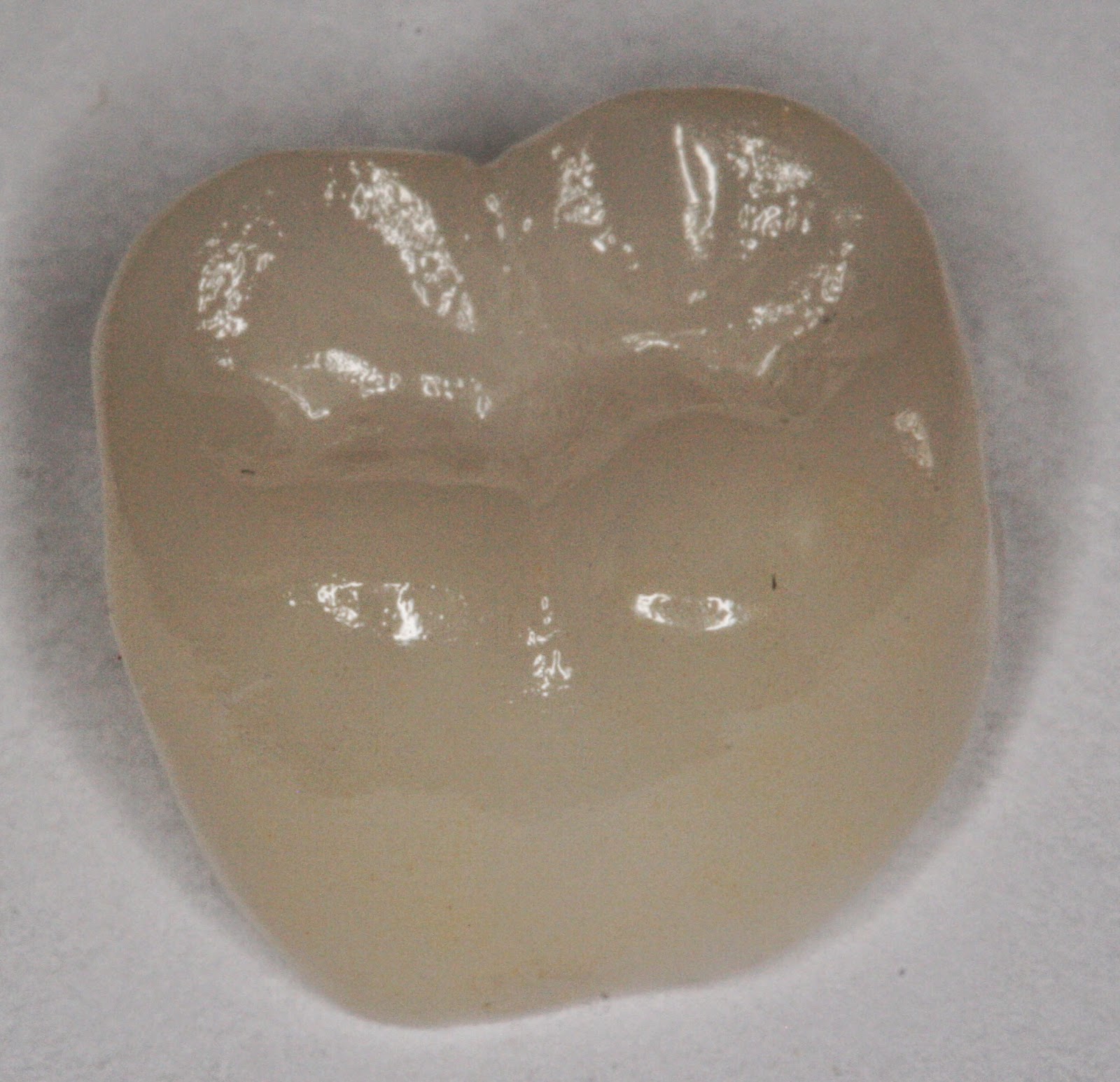
   A crown is replacement for the enamel, the outer layer of the tooth. A crown is used when the enamel is broken, stained, misaligned or weak. The crown, or cap,  provides strength and protection for the underlying tooth.
   Crowns used to be made of metal alloy, porcelain, or a combination of both. Modern crowns are usually made from high strength, tooth colored ceramic. See  our video for a demonstration of their strength- search YouTube for "Doctor Adrian crown strength.”
   The procedure takes two appointments. First the tooth is shaped and an impression and temporary are made. In 3 weeks we place the final crown.
   How long a crown lasts depends on 3 factors:
          How good is the dentist
          How good is the lab

          How good does the patient take care of it

A case of a cracked tooth. Biting caused pain.

The light makes the cracks more apparent

The ceramic crown
 Inside
 A new tooth

Thursday, October 2, 2014

Grinding, or "Lips Together, Teeth Apart."

     It seems like I give this speech several times every day. Now I can just refer to this blog post!

     If everything is working correctly, you shouldn't even be aware of your teeth or bite. If your bite bothers, your jaw joint hurts, or I complain about tooth wear- we have a problem.

     If you grind, usually the front teeth wear. Clenching wears the back teeth. Either one can bother the joint.

     The normal wear rate for enamel is about 30 microns per year, so 1 mm in 30 years. If you have worn 3 mm off your teeth, not uncommon, you have the teeth of a 100 year old! I used to tell patients, you have the teeth of a __ year old, but the girls made me stop. It sounded too mean.

     If you have any of these issues, your teeth should never touch. Really, never! The teeth touching is what has caused the problem, so it just needs to stop. When you chew, food is between the teeth so that doesn't count. Most of us clench with stress- when freeway traffic is bad, when a child throws a fit, or when we have a dental appointment coming up. During the day, it's a matter of becoming aware of your clenching. I have seen hypnosis therapy used. The post-hypnotic suggestion is, "Lips together, teeth apart."

     Grinding at night obviously can't be stopped consciously. It is usually stress related. Many people start grinding in college, then it becomes a firmly entrenched habit. The solution is a bite guard. They can be smaller than the NFL style. The guard will prevent tooth wear, and usually stops the grinding. 20% of patients still grind, but at least it's acrylic that grinds away, not enamel.

     Children often grind their baby teeth. It's not stress, the cause is actually unknown. Many kids grind their teeth so flat that only a little disc is left when the tooth comes out. Only a small percentage of kids keep grinding when their permanent teeth come in. If the grinding continues, then it's a problem, we don't want wear on those teeth. I know how terrible it sounds, but ignore it. Close the bedroom door.

     The TMJ is a ball and socket joint. Instead of being a simple hinge, the joint can slide around so you can chew. A disc in the joint enables the sliding. The disc is held in place with ligaments. The most common TMJ problem is when the ligaments are damaged and the disc pops out of position. It makes a popping noise, sometimes makes it hard to open or close, and hurts. The first thing to do for TMJ is to be nice to the joint. If your knees hurt, it's time to stop running and do a different excercise. With TMJ, it's no more hard food like beef jerky or sourdough bread. Be careful not to open too wide. Don't clench or grind, don't even let your teeth touch in the daytime. At night wear a bite guard. If you are in the 20% that still grinds with a guard, it should still help. It holds your jaw down and forward and only touches in the front. That minimizes the pressure you can put on the joint. If it still hurts after (1) being nice to the joint and (2) wearing a nightguard, it's time to see a TMJ specialist.

    Give us a call if your bite needs to be evaluated.

Thursday, September 11, 2014

New Dry Mouth Treatment

This is a new treatment for a miserable problem. It's a medicated patch that sticks to your cheek. We have seen some good results. It only costs about 50 cents per patch. It's available at Walgreens or online. Here's their info-

OraMoist dry mouth treatment is a small, tablet-sized patch that adheres easily and comfortably inside the mouth and then slowly dissolves. It releases ingredients that lubricate and moisten the mouth, and other ingredients that stimulate natural saliva production. Just hold the patch to the roof of the mouth or inside of the cheek for 10 seconds to get it to adhere. OraMoist works extremely well as a dry mouth treatment at night - often all night. During the day, the patch lasts up to 4 hours.

Wednesday, September 10, 2014

How to Choose a Dentist

Everyone would like to have a straight, white smile. Dentists know this. Dentists would love to do more cosmetic dentistry. Today, most dentistry should be some form of cosmetic dentistry. But, with so much choice out there, how do you choose a cosmetic dentist right for you?
Remember that you are placing your aesthetic future in someone else's hands—literally. You want to make sure that this person is qualified, experienced, and able to meet your specific needs. So shop around. Many cosmetic dentists offer free consultations. Take advantage of these offers. Visit a few different cosmetic dentists. As you do your research, consider the following things:

Training and education. It's pretty safe to assume that most dentists have a fair bit of dental education. But how much do they really know about cosmetic dentistry? Dental school training is at an introductory or general level. Many dentists never attend further training beyond reading "What's New" columns. To stay at the top level, dentists must constantly attend workshops and seminars and, especially, attend hands-on training to keep up with rapidly evolving materials and technology. A dentist who invests time, money and energy to his or her own continuing education demonstrates a commitment to achievement, and to patient satisfaction.

Honesty. A good cosmetic dentist will be upfront about what he or she can do for you, how much time it will take, and how much post-treatment maintenance you will have to do. Anyone who tells you about "quick and easy" fixes is trying too hard to sell you his or her services.

Communication. You want what's best for your teeth. So, too, should your cosmetic dentist. Choose one who listens and makes sure he or she really understands your needs. Remember, you're looking for a course of treatment tailored to your specific aesthetic goals, so seek a cosmetic dentist who will customize a plan for your teeth. Conversely, make sure you understand your dentist. Go for someone who describes in detail what he or she proposes to do, and clearly answers your questions.

Artistic Eye. Remember, these are your looks at stake. Make sure your cosmetic dentist considers not only what will work best for you, but what will look best for you as well.

Experience. Practice makes perfect in cosmetic dentistry, just like anywhere else. The more experience a dentist has had performing various cosmetic tasks, the better he or she will be at it. Ask potential cosmetic dentists how much experience they've had in the type of procedure in which you are interested.

Before and After Photos. Every good cosmetic dentist has a collection of these photos available for patient viewing. Look at them, and pay special attention to cases similar to yours. The photos should be high quality and show amazing detail. Careful, some dentists might have purchased a photo set containing generic photos of cosmetic dentistry success stories. Be sure that the photos you see depict actual clients of your dentist.

References. Ask other patients about their experience with a potential dentist. A Google search can reveal a lot. Google reviews can be a good resource. It's not perfect, it is possible to cheat the system, at least for a while. I think a bad review or two is a good thing.  It shows that the reviews aren't totally rigged, and no business can please everyone. I believe that before any medical practitioner treats you, you should check Google and online reviews. Also, you can phone the State Licensing Board to inquire if any complaints have been filed against the dentist. You can check for disciplinary actions at www.dopl.utah.gov.

Tour of the Facilities. Finally, have a look around the office. This is your opportunity to see the equipment, ask questions about available technology and procedures, and check out the sterilization areas.


Other things to watch for. The dentist should listen to what you want. It’s not, “yes doctor, whatever you think is best,” anymore. The days of the guy down the street making crowns in his basement are over, too. Ask which lab will be used and check their website. Ask to see lab work of a similar case. The lab work should be neat and polished, not sloppy.  The dentist should have nice teeth. They should be white and probably have no silver fillings. It shows if he really believes in cosmetic treatment. The office should run smoothly, there shouldn't be too many miscommunications or too much employee turnover. There should be enough assistants. Modern techniques require more hands than the dentist and one assistant. The dentist should be interested in conservative treatment. If the recommendation is a crown for every tooth that has a filling- red flag. Long appointments for extensive work are not easy. The dentist should be experienced with a variety of drugs to make the appointment easier. The dentist should be very concerned about your comfort, remember special requests and not be rough or heavy-handed.  Attention should be paid to the health of your gums, your jaw joint and bite.  Cosmetic dentistry is not a “recognized specialty.” If a dentist claims to “specialize” in cosmetic dentistry, they are guilty of poor use of the lingo at least, deception at most. 

   There are dentist's out there who are caring , honest, and talented- choose one of those!

Wednesday, August 13, 2014

Got Cold Sensitivity?

     Cold sensitivity can really hurt! It usually happens because the gums recede and root surface is exposed. A cavity can also cause it. Make sure it's not a cavity before you take any of the advice in this post. The root of the tooth has pores that open to the nerve inside the tooth, so cold will cause the nerve to hurt.

Sensitivity Toothpaste

     Sensitivity toothpastes contain chemicals that are supposed to get to the nerve and prevent the nerve from firing. It seems like a goofy strategy but they can be somewhat effective. The effect won't last very long.

Crest Sensi-Stop Strips

     The strips contain oxalates which form crystals which block the pores. "1 strip, 10 minutes, 1 month protection." That will depend on the amount of exposure to acids that dissolve away the crystals. That includes mostly acid from plaque and also from foods- citric acid from fruit, phosphoric and carbonic from soda, acetic from pickles. They come in a 3 pack for about $35.

Fluoride

    This is my favorite solution. When the gums recede beyond the enamel, the root surface is not only susceptible to cold but also to decay. Fluoride protects against both. It will block the pores and also soak into the tooth for decay protection. 
   Crest Pro-Health and some of the Sensodyne pastes have stannous fluoride which I think is best. Boring chemistry alert! The rest of this paragraph is only for nerds. It's too boring for normal people. Stannous fluoride is better because it has substantivity- meaning it will chemically bond to teeth and gums so everything is exposed to fluoride for hours. Other forms of fluoride wash away in minutes. Crest had stannous in it in the 50's, but it caused staining. The staining would polish right off with a professional cleaning, but that didn't help sales much. Now the genius chemists at P&G have solved the problem. It's something about a ring structure that surrounds the stannous fluoride molecule, still gives the protection but prevents staining.
   The strategy is to use the Pro-Health every time you brush. At night, don't rinse after you brush, go to bed, salivary production decreases and you get several hours of fluoride exposure. Continue to use the stannous paste because acids continue to etch it out of the tooth. For severe cold sensitivity, you can rub a bit of the toothpaste on the spot several times a day. It might even sting a little, that's just the fluoride going into the pores. Keep using the toothpaste and cold things should be much more confortable.

Thursday, December 5, 2013

How to have Perfect Teeth

   I love doing a checkup and telling a patient their teeth are perfect. Here are the things you need to do to hear me say that at your exam.

Clean your Teeth

   Clean your teeth every time you eat something. Brushing is best; mouthwash or even swishing water helps. Brush for a full two minutes twice a day. It's almost impossible to brush that long without a timer.  A good ultrasonic electric brush is better. It can disrupt plaque better, and it has a timer.
   The type of paste used is less important than how well you brush, but we like Crest Pro-Health the best. It has a modern version of stannous fluoride, which is better for some really boring chemical reasons.
   Mouthwash? Everybody wishes there was a magic one but there isn't.
   You need to clean in between the teeth every day- floss, water pik or toothpick. Only a small percentage American's floss. I think that one reason is because of the learning curve, if it feels awkward it's hard to keep doing it. We'd be glad to work on your technique with you. A water pik will do a great job. The technology is better now than the one your Grandma has on her bathroom counter. We love a model that's only $25 and will stow away in a drawer. European dentists recommend toothpicks, but then they have awesome European toothpicks. Fortunately they're also available here. Don't use too large of a pick for a space or it will create a space- the gums will recede.

Fluoride

   Fluoride for kids- Fluoride helps a lot when it's built into developing teeth. It's great that fluoride is in the water, but it's hard to tell how much your child is getting. Is there fluoride in bottled water? Does your fridge or other filter remove it? It's difficult to tell. Here are some things to do that help- Drink tap water. Use a little fluoridated tooth paste even for the little ones. Fluoridated water is good for adults, too. You get a little fluoride to soak into your teeth every time you drink water. Again, drink tap water.

Diet

   Sticky foods are bad, they hang around on the teeth for a longer time. Acidic foods are bad: soda, pickles, citrus fruits. Even diet soda is acidic. Sweets are bad, even juice, because the bacteria in plaque convert it to acid. It's best to brush every time you eat.

Regular Professional Cleanings

   Gingivitis (inflamed gums) is the most common disease on earth. It needs to be controlled or it progresses to worse things.You can clean plaque off your teeth at home, although a hygienist can do it better. Tartar is the hard stuff, you can't get it off yourself. Some people form lots of tartar quickly, others not so much. Twice a year isn't necessarily best for everyone. Some might need 4 cleanings a year, others only one.

Xylitol

   This is a natural substance that can inhibit the bacteria that cause damaging plaque. It's available in mints, gum, and mouthwash. The amount in regular gum is probably not enough to help much. If you're going to try this you should use it 5 times a day, "strive for five."

Dry Mouth

   Saliva is very important to rinse away stuff, also to buffer acid attack. Decay can go crazy if your mouth is often dry. Most toothpaste contains detergent, which can be drying. Biotene is one of the few pastes that contain no detergent. It also has enzymes and other things that can be low if your mouth is dry. Biotene also makes a rinse, spray, and gum. Sipping water all through the day will also help.

Crooked Teeth

   There are a lot more little places for  trouble to start if the teeth aren't lined up straight. These days there can be easier ways to straighten teeth than 3 years in braces.


Thursday, November 29, 2012

Now It's Mom's Turn

Here's a scenario we see quite often- Mom is finally turning the last of her little chicks out of the nest. She has been totally sacrificing herself for the last 25 years or so; sacrificing her time, her own interests, even her body. She has been keeping up with dental checkups for everyone, all the wisdom teeth are gone. Her teeth have been sacrificed too. She has been maintaining her teeth, but now they need more. It's time to get her smile to where it looks good, feels good and will last a long time. Sometimes it needs a lot of work, sometimes it really doesn't take that much.
   We fixed Tatiana's smile 8 years ago. It was quite a commitment to get her smile to where she wanted it to be. Her youngest son was just finishing High School. When we fixed her smile she looked like a new woman. Her oldest daughter has a gorgeous smile so we used her teeth as a guide. At Tatiana's last checkup she said, "I still love my teeth! I still get a comment about my smile every week! You're the best."
   Last summer Kathryn's youngest son had just graduated from high school. Another son had just finished his mission. We fit veneers into her schedule just in time for her to travel to Amsterdam before her son's wedding. She loves her new smile; Amsterdam, not so much!
   Sondra was totally committed to her husband and nursed him through a terminal illness. It took several years. When she was able to take care of herself, she had her smile overhauled. We admire her so much. She is the most amazing woman. Now she has an amazing smile.
  God bless the Mom's. All of us are grateful for the sacrifices they have made for us. If it's Mom's turn for the woman in your life, we'd be glad to show you what the options are.
  

Wednesday, October 24, 2012

Wisdom Teeth War Erupts in Utah

   The oral surgeons of Utah County have their underpants in a great big bunch. At issue is a general dentist operating as "Wisdom Teeth Only." You may have seen his billboards along I-15. The oral surgeons paid for a billboard that says "Heath Hendrickson of Wisdom Teeth Only is NOT an Oral Surgeon." They have made a website called trooth.com, get it? Don't you love the photo? I believe that one of the most important things that I do is to help people get over their fears. It's one of the most rewarding things I do. I love it when I can build a more trusting relationship with those who have been traumatized, usually by schlocky dentists. Then these idiots put out this picture.
   Last Friday they actually picketed his office!! For those who may care why a bunch of highly educated "professionals" would be acting like 2nd graders, here's the explanation.
   Heath Hendrickson is a general dentist. I guess he liked doing wisdom teeth. He bought a practice from an oral surgeon in Provo that was named Wisdom Teeth Only. Apparently his niche is lower prices, he can do it for less than the specialists. He takes even the crappy insurances. He and his brother now have several offices by that name. Apparently there are so many dentists in Utah that he has put the oral surgeons in more of a pinch.
   Here's the back story. Dental school is 4 years after college. You're called a general dentist and you can do root canals, wisdom teeth, whatever you're comfortable with; hopefully only what you do well. After that you can go to school for a few more years and be a specialist- orthodontist, endodontist (root canals), pediatric dentist. Or a few to a lot more years and be an oral surgeon. Most oral surgery programs now give you an MD degree.
   The bureaucrats have had endless meetings and decided that a general dentist can say they have a practice "limited to oral surgery." You must tell patients that you are a general dentist and that they have the right to go to a specialist. You also can't use the word special or specialist or specialize.  They have also decided that a patient can sue for malpractice if the general dentist did not do what a reasonable specialist would have done.
   There are, of course, turf wars. There can be turf wars between oral surgeons and plastic surgeons. One of the big advertising "plastic surgeons" in Utah is actually a dentist who became an oral surgeon. There are turf wars between insecure plastic surgeons and dermatologists.
  I think the bottom line is not what degree you have, it's how good you are. Most of us who went to school 20 years ago could no longer describe the front door of the place. I can't and I've been back many times. I've given them lots of money. It's not what you knew 20 years ago, it's what you know now. I have nothing against other oral surgeons. I don't like doing wisdom teeth. I'm not jealous of oral surgeons. I'm glad they're around. I'm pretty impressed with the surgeons that I refer patients to.
   A degree is no guarantee. The number of letters after the name is no guarantee. There is an oral surgeon right now in the south valley who has a drug problem. The records are public at dopl.utah.gov. He lost his license in New York, but is on probation here, working every day. There is an oral surgeon in Layton who the records describe as a drug and sex addict. He is not allowed to be alone with a patient of either gender. He's not even on probation anymore. An oral surgeon in Ogden used to have patients wake up with their clothes buttoned up wrong- just like the Seinfield episode! He finally quit. I know a periodontist (gum surgeon) who did so may drugs that she started surgery on a patient after she had forgotten the anesthesia! She is still working in Salt Lake.
   The other bottom line is that patients should research anyone who is gong to treat them. Most of the bad news is on google. Things like malpractice, license probation and crimes will show up. A single bad google review is not terrible, it's realistic. Someone gave me a bad review. If there aren't any bad reviews they may be stacking the deck. Good luck choosing, and research carefully

Friday, April 27, 2012

The "Adrian X-Ray Shoe Fitter" and Musings on Radiation

The Adrian fluoroscope was a popular device in shoe stores from the 1920's to the 1960's. They were used in the UK into the '70's! About 10,000 machines were in use in the US. It was a cabinet about 4 feet tall. You would put your kids foot into an opening in the base and look into a view port in the top. There was often 3 ports- one each for the child, the parent and the salesman.  As the x-rays poured through, you could clearly see the child's toe bones wiggle inside the new shoe. The exposure time was adjustable, usually about 20 seconds.

The dangers of x-rays were known much earlier. One of Thomas Edison's glassblowers, who made the tubes, would test the tubes on his hands. He developed such a tenacious cancer that his arms were amputated and he eventually died. Edison subsequently completely abandoned x-ray research in 1903.

Apparently the shoe fluoroscopes did not result in widespread public health problems. But in a worst case scenario (trying on multiple shoes, maybe damaged shielding in an old machine) a high enough dosage to result in radiation sickness could have resulted from a single visit. Several cancers were reported- salesmen who would test machines on their hands, even a shoe model whose legs had to be amputated. This silly technology was eventually banned.

Now this month we have the stoopid study from the American Cancer Society that resulted in stooopid headlines like "dental X-rays give you brain tumors." The study has resulted in widespread accusations of junk science. It was based on sick old people trying to recall how many dental x-rays they had in childhood. Dr. Nancy Snyderman's report on NBC was especially bad. I hope the x-rays they showed in the background were hers. They were a monument to poor decision making- multiple molars with root canals and no crown, root canal on a wisdom tooth. I think the radiation is going to be the least of that patients problems.

More stoopidity- the American Dental Association has come up with this gem of a guideline in regard to radiation- "As Low as Reasonably Achievable." I can easily achieve zero exposure- don't take any! How's that! This is how I believe that you should decide how many x-rays to get- have a discussion with your dentist about the benefits and risks. Of course we should all limit the amount of radiation we receive. A  dental x-ray dose is about the amount the average US resident gets from living for 2 days. This comes from outer space, from materials in the earth and materials in our food. A coast to coast flight is 3 times higher, a hip x-ray about 65 times more, a shoe fitting fluoroscope about 85 times higher.  The benefits of dental x-rays is to find problems when they're small. Yesterday I saw the Director of one of the largest insurance programs in the state. He hasn't had an x-ray lately and a cavity progressed to the point that he needs a root canal and a crown. It will cost over $2,000. An x-ray and a small filling would have cost less than $200 and insurance would have covered over 80% of that. Not everyone should get the same amount of x-rays. It might be a good idea for someone who has recently had cavities to get x-rays more than once a year- even though insurance might not cover it. Someone who hasn't had a cavity in a long time might want to go 18 months- even though insurance would pay yearly.

The bottom line is to make smart decisions. Life is often harder for those who make stoopid ones.

Wednesday, March 28, 2012

If Auto Insurance was Like Dental

If auto insurance was like dental insurance-

The executives would make lots more money! My insurance, AutoOwners, pays it's CEO about $300,000. At the height of the recession, Delta Dental paid 5 execs over $3 million a year.

Your insurance would pay 100% for oil changes and wiper blades. They would only pay half if your car is wrecked , and only up to a total of $1,000/year; $500 if its a cheaper policy. They would try as hard as they can to get out of paying the $1,000- pre-existing conditions, non-duplication of benefits, waiting periods, etc.

Your benefits would not be indexed for inflation. The yearly max. was $1,000 in the 1960's, which would pay for a new Beetle. It would still be $1,000, which wouldn't even repair one bumper

Your employer would select your auto insurance company, and pay the premiums. There would not be any gecko ads, or the crazy Allstate guy.

So don't expect your dental benefits to be like insurance. It's actually an employee benefit that pays well for maintenance, but poorly for repairs, and next to nothing for overhauls.

Tuesday, January 17, 2012

Xylitol- Another Tool for Decay Prevention


Xylitol, pronounced zylitol, is a naturally occurring sugar substitute. It's extracted from corn husks in the US, rice straw in China, and Birch trees in Finland. Through a couple of very cool, to a dentist, mechanisms, xylitol is good for teeth and bad for plaque bacteria. If you're actually interested you can read all about it at xylitol.org. Several studies show a 60% reduction in cavities.
Who needs it? Anyone who doesn't floss or waterpik enough, has ever had a root canal, or ever had a checkup with more than one cavity. That includes children. Want to decrease the chance of your baby getting decay by 60%? One study showed that result for new moms who chewed the gum from the child's age of 6 months to 2 years. Amazing! It affects the transmission of decay causing bacteria.
So how do you get xylitol? If you're the type who reads ingredient lists you know that most sugarless chewing gum has it. The problem is that it doesn't have enough. Research shows that you need around 4 to 6 grams per day. Most gum has other sugar substitutes but only .1 grams xylitol . Gum and mints that are made for dental benefits have 1 gram of xylitol. So 4 to 6 pieces of the right gum or mints gives the recommended daily dose. Too much can give you the runs.
Where do you get it? The biggest producer is a company in Orem, surrounded by wacky multi-level nutritional companies. They claim to be the largest importer of xylitol in the US. To me that means they get it from China. Smart Sweet does not contain Chinese xylitol and is available online here. Ultradent is a Salt Lake dental company that makes a line of xylitol products- gum, mints, mouthwash. They have tested Chinese ingredients and will not use them. They are a great company run by great people. We will be stocking their products, and using them ourselves. We'll sell them at our cost which turns out to be less than the competitors. Ask for a sample at your next check up.

Wednesday, November 30, 2011

Saint Apollonia Patron Saint of Dentistry


Saint Apollnia is the patron saint of dentistry, also for those suffering from toothache. She was one of a group of virgin martyrs who suffered in Alexandria in about AD 250. A mob threatened to burn her alive if she did not deny her faith. She refused so the mob broke all her teeth and threw her into the fire. Miraculously the fire did not harm her. She ended up decapitated.
Her feast day in celebrated on February 9th. She is represented in art with pincers in which a tooth is held. She is one of the two partron saints of Catania, Sicily. In Germany she is one of the Fourteen Holy Helpers that are singled out as the patron saints of daily life; Apollonia protecting against toothache. Her relics were preserved in the Church of St. Apollonia in Rome, which no longer exists. Her head went to a church in Trastevere, her arms to a Papal Basilica in Rome and parts of her jaw to St. Basil's. Other relics, sometimes a single tooth, to several churches in Belgium and France. One of the principal train stations in Lisbon is named for her. The Island of Mauritius was originally named for her in 1507 by Portugese navigators. In England, there are 52 known images of her that remain in various churches, mostly in stained gless.
Most Effective Pain Pill for Wisdom Teeth
This month's British Dental Journal has a study on this topic from Oxford. The winner- ibuprofen and Tylenol together! That's one ibuprofen and one extra-strength Tylenol! It achieved a tie with a COX-2 inhibitor not available in the US. They scored the percentage of patients who started out with moderate or severe pain and achieved at least 50% pain relief.

Ibuprofen/Tylenol scored 74%
Naproxen (Aleve) and 2 ibuprofen (separately) "scored well"
Lortab was only 24%
Placebo was 7%. It's always amazing how well placebos do.

Pain control is tricky. This study shows that even the best drugs fail to provide good relief in 30% of patients. No single drug is effective for everybody. Some people believe that a drug must make you stoned to really relieve pain- probably not true. While narcotics (Lortab) do make you sleepy, they also causes nausea, dizziness, constipation and massive problems with addiction. There are probably better medications to make you sleepy. The conclusion of the authors of the study was that if one medication doesn't give you relief, try another.

Monday, January 3, 2011

Think about this before genetic testing

It used to cost a million bucks to have your genes sequenced, to get a print out of all your DNA. It now costs about 20 grand. Recent developments should bring the cost down to much less than a thousand. There are many issues to think about before you buy any genetic tests- including the periodontal disease tests that I have been recommending. One important issue is to keep your information private. You don't want the insurance companies to know what your risk of any disease is. Their job is to share the risk in general, and charge appropriate premiums. Don't give them the answer so they can charge you more!
I made a mistake with my elbow. I went to the M.D. who diagnosed tennis elbow and sent me to physical therapy. When he makes the diagnosis, the medical insurance will cover it. Six months later, the physical therapy didn't help and it affected my insurance rate. Not only medical insurance, I paid more for life and disability insurance for years. I will probably buy some genetic tests at some point. I just think the science is cool. It may also help make some decisions in the future. But I will carefully protect my private information. I don't want any insurance company to know. I don't want my M.D. to write anything down. Of course we protect your privacy with the gum disease tests, no results are reported to anyone but you.

Monday, November 22, 2010

Breast Cncer and Gum Disease

The first study showing a link between breast cancer and periodontal disease was just published. The study was done at The Karolinska Instute and published in Breast Cancer Research and Treatment. Periodontitis seems to be closely associated with human cytomegalovirus and Epstein-Barr and Herpes virus co-infection. It is believed that these viruses act together to suppress immune response to bacterial challenges. The authors conclude that these viruses and bacteria act together to lead to low-degree chronic inflammation and carcinogenesis.