Wednesday, December 20, 2017

What the Heck are Tonsil Stones?

Tonsils apparently evolved to protect us from bacteria and viruses. They don't work very well in our modern world. People with tonsillectomys don't get any more colds than people with tonsils.

 The nooks and crannies that are supposed to catch bacteria can sometimes cause other problems. One problem is tonsil stones. The same bacteria that cause plaque can build up and trap other debris like dead cells and food. This glob can then become calcified like tarter.

Many people aren't even aware that they have tonsil stones. They are often discovered on an xray or CT scan like a dental panoramic. They aren't that rare, we see them all the time. They can become irritating and cause a sore throat, irritation with swallowing, or a scratchy feeling.

 Sometimes people can cough out the stone if it bothers them. Some can pick them out with a Q-Tip. Don't use anything sharp to poke them out! You don't want to make your tonsils bleed. A water pik may be the best way to get them out. Search for 'water flosser' on Amazon. My favorite connects to the shower head. A tonsillectomy will prevent stones but may not be worth it. Rinsing and gargling with warm salt water can help loosen them.

Bad breath from the bacteria is sometimes a result. Gargling with an antiseptic mouthwash can be helpful. BreathRx has zinc and a POWERFUL mint flavor. CloSys has chlorine dioxide and a mild mint flavor. Listerine has essential oils, is widely available and inexpensive. They can help to prevent the growth of the stones.

ENTs have used lasers or 'radiofrequency coblation' for 'tonsil resurfacing.'  The idea was to zap off the dimples on the tonsils. These procedures have not become widely used.

Sunday, August 20, 2017

Merwe Castle and the Origin of My Name

The Merwede, Merwe in medieval Dutch, is a river in the Netherlands. It flows from  a branch of the Rhine to the sea and has changed course several times due to huge floods. So Van de Merwe means from the Merwede River.

In 1015 Count Dirk III of Fresia founded the city of Dordrecht, now in the Netherlands, and built a castle on the bank of the Merwede. The knights of Merwede fought in the first four crusades and brought back many relics. A Lord Daniel took the first tower of Constantinople. When he returned he commenced building a second castle outside the City of Dordrecht. Lord Daniel V built an expansion of the castle in 1335. Daniel VII died without a male heir in 1403 ending the direct line. 

The castle was partially destroyed during a siege in 1418 in a war over the Countship of Holland. Later that year a huge flood devastated the countryside. Three years later the St. Elisabeths flood caused massive destruction in South Holland, 72 villages were submerged. The strong ice of that winter cracked the castle walls which eventually collapsed. The people of Dordrecht took bricks fallen from the castle to build their cathedral and restore the city walls. Only a remnant of the keep facing the city remained standing. The ruins stood in water for the next 600 years until the area was reclaimed in the early 20th century. In 1940 archeological excavations began, and in 1971 the remaining walls were stabilized.

Wednesday, August 3, 2016

You Don't Need to Floss?!

OK, when the media reaches the conclusion that studies show that you don't need to floss, I need to comment. The conclusion is wrong, but it's actually accurate to say a study has never proved that flossing reduces decay.

The problem is with the difficulty of dental hygiene studies. If you try to do a double blind study, as soon as people know the study is about flossing- they floss! Even if they otherwise never would. If they know it's about brushing, they brush better. Almost no one will brush for a full 2 minutes without a timer. The average American brushes for more like 20 seconds. If you try to do a retrospective study and ask people how much they flossed 10 years ago, the answers are garbage! People don't remember, and they almost always give themselves more credit than is due. It's like asking people to write down everything they eat, most lie! At best people don't report actual portion sizes.

So it hasn't been proved in a study that flossing prevents decay. It has been shown that it reduces gingivitis and gum disease. And science has shown that you must "disrupt the biofilm" on teeth or it caused problems. That means you must disrupt the organization of the bacterial plaque. It's not technically about removing food, or even "cleaning" the teeth. You must prevent the bacteria from building a more solid structure of plaque- the junk on the teeth. That's when the damage occurs. This must be done between the teeth, too.

Flossing is not the only way to "clean" between the teeth. A water pick can do it. I like this one. A tooth pick can do it, if you're really good at it. An African chew stick can do it. Something has to get in between the teeth every day. Studies have shown that is the interval required for "biofilm organization disruption." That just isn't as snappy a headline as  "You don't need to floss now!"

Tuesday, March 17, 2015

Dry Mouth?

   A dry mouth can be miserable. Saliva also has several important functions.


  • Lubrication- it makes you feel better, makes it possible to swallow food, and speak.
  • Digestion- it actually has enzymes that start digestion.
  • Cleaning- it helps to wash away food debris. It chemically buffers acid attacks from plaque or from acidic food or drink (Diet Coke!) Decay rates can skyrocket without enough saliva.
  • It somehow helps keep the 1,000 different kinds of bacteria in your mouth in balance. Yeast infections and bad breath can result from imbalances.

Causes of dry mouth

  • The most common cause in younger people is a medication side effect. This is possible with many medications.
  • Sometimes the salivary glands just don't work like they used to.
  • Detergents in toothpaste are drying.
  • Diseases like Sjogren's.
  • Radiation and other medical treatments can harm salivary glands.
  • Lifestyle- smoking, mouth breathing due to tonsils, congestion etc.

Solutions (or at least aids)


  • Water, sips all day long, a sip with every bite at meals, carry a bottle (or a flask!)
  • Use a toothpaste without detergent. Detergents make the toothpaste foam. Americans like foaming cleaners, scrubbing bubbles! It's usually listed on the ingredients as a laureth sulfate. It's great for cleaning grease but not really helpful for toothpaste. Almost all of them have detergents. One that doesn't, and is widely available, is biotene. 
  • biotene has other products like sprays, mouthwash, rinses and gum. They all contain helpful lubricants and enzymes.
  • Mints and gum will stimulate saliva production. For heaven's sake, sugarless! 
  • Oramoist is a long lasing patch that sticks to gums. It gradually releases lubricants and stimulates salivation.
  • There are prescription medications, such as Salagen, that can stimulate salivary glands. Of course it won't work if the glands don't work at all.
  • If the cause is a medication, sometimes a different one can be tried, or the dose adjusted.
  • Use a vaporizer to humidify bedroom air. 
    Don't ignore a dry mouth. The dental consequences can be severe, and some of the treatments are pretty easy.

Tuesday, January 13, 2015

What is a crown?


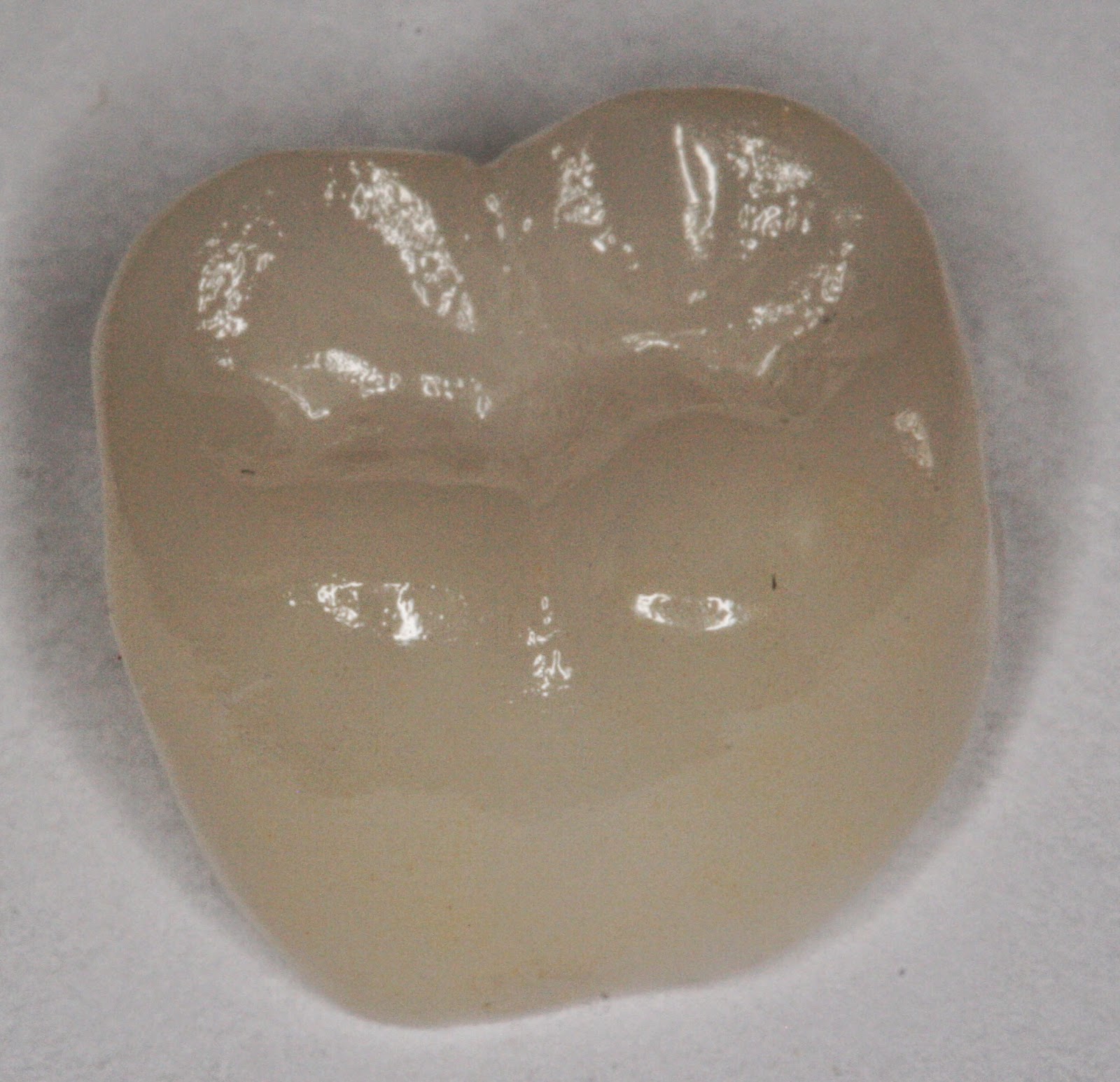
   A crown is replacement for the enamel, the outer layer of the tooth. A crown is used when the enamel is broken, stained, misaligned or weak. The crown, or cap,  provides strength and protection for the underlying tooth.
   Crowns used to be made of metal alloy, porcelain, or a combination of both. Modern crowns are usually made from high strength, tooth colored ceramic. See  our video for a demonstration of their strength- search YouTube for "Doctor Adrian crown strength.”
   The procedure takes two appointments. First the tooth is shaped and an impression and temporary are made. In 3 weeks we place the final crown.
   How long a crown lasts depends on 3 factors:
          How good is the dentist
          How good is the lab

          How good does the patient take care of it

A case of a cracked tooth. Biting caused pain.

The light makes the cracks more apparent

The ceramic crown
 Inside
 A new tooth

Thursday, October 2, 2014

Grinding, or "Lips Together, Teeth Apart."

     It seems like I give this speech several times every day. Now I can just refer to this blog post!

     If everything is working correctly, you shouldn't even be aware of your teeth or bite. If your bite bothers, your jaw joint hurts, or I complain about tooth wear- we have a problem.

     If you grind, usually the front teeth wear. Clenching wears the back teeth. Either one can bother the joint.

     The normal wear rate for enamel is about 30 microns per year, so 1 mm in 30 years. If you have worn 3 mm off your teeth, not uncommon, you have the teeth of a 100 year old! I used to tell patients, you have the teeth of a __ year old, but the girls made me stop. It sounded too mean.

     If you have any of these issues, your teeth should never touch. Really, never! The teeth touching is what has caused the problem, so it just needs to stop. When you chew, food is between the teeth so that doesn't count. Most of us clench with stress- when freeway traffic is bad, when a child throws a fit, or when we have a dental appointment coming up. During the day, it's a matter of becoming aware of your clenching. I have seen hypnosis therapy used. The post-hypnotic suggestion is, "Lips together, teeth apart."

     Grinding at night obviously can't be stopped consciously. It is usually stress related. Many people start grinding in college, then it becomes a firmly entrenched habit. The solution is a bite guard. They can be smaller than the NFL style. The guard will prevent tooth wear, and usually stops the grinding. 20% of patients still grind, but at least it's acrylic that grinds away, not enamel.

     Children often grind their baby teeth. It's not stress, the cause is actually unknown. Many kids grind their teeth so flat that only a little disc is left when the tooth comes out. Only a small percentage of kids keep grinding when their permanent teeth come in. If the grinding continues, then it's a problem, we don't want wear on those teeth. I know how terrible it sounds, but ignore it. Close the bedroom door.

     The TMJ is a ball and socket joint. Instead of being a simple hinge, the joint can slide around so you can chew. A disc in the joint enables the sliding. The disc is held in place with ligaments. The most common TMJ problem is when the ligaments are damaged and the disc pops out of position. It makes a popping noise, sometimes makes it hard to open or close, and hurts. The first thing to do for TMJ is to be nice to the joint. If your knees hurt, it's time to stop running and do a different excercise. With TMJ, it's no more hard food like beef jerky or sourdough bread. Be careful not to open too wide. Don't clench or grind, don't even let your teeth touch in the daytime. At night wear a bite guard. If you are in the 20% that still grinds with a guard, it should still help. It holds your jaw down and forward and only touches in the front. That minimizes the pressure you can put on the joint. If it still hurts after (1) being nice to the joint and (2) wearing a nightguard, it's time to see a TMJ specialist.

    Give us a call if your bite needs to be evaluated.

Thursday, September 11, 2014

New Dry Mouth Treatment

This is a new treatment for a miserable problem. It's a medicated patch that sticks to your cheek. We have seen some good results. It only costs about 50 cents per patch. It's available at Walgreens or online. Here's their info-

OraMoist dry mouth treatment is a small, tablet-sized patch that adheres easily and comfortably inside the mouth and then slowly dissolves. It releases ingredients that lubricate and moisten the mouth, and other ingredients that stimulate natural saliva production. Just hold the patch to the roof of the mouth or inside of the cheek for 10 seconds to get it to adhere. OraMoist works extremely well as a dry mouth treatment at night - often all night. During the day, the patch lasts up to 4 hours.